If your stream picks up a whirring fan, a clacking keyboard, or the neighbor’s dog, the fix is usually already sitting inside OBS. OBS Studio has a built-in Noise Suppression filter that cleans up your mic in a few clicks, and for heavier noise you can add a noise gate or route in a dedicated AI tool.
This guide walks through every option: the three built-in noise suppression methods (RNNoise, Speex, and NVIDIA Noise Removal), when to use each, how to set up a noise gate, and what to do when your audio comes out muffled. If you’re also setting up your capture, our guide on how to record with OBS covers the rest of the workflow.
Everything here reflects the current OBS Studio 32.1 release, which shipped an overhaul of the audio mixer.
Does OBS Have Built-In Noise Suppression?
Yes. OBS Studio includes a Noise Suppression filter you can apply to any audio source. It’s good at steady background noise like PC fans, air conditioning, and room hum, and it needs no plugins or extra downloads to get started.
What it won’t do is miracle-work on loud, chaotic noise (a café, a construction site, kids in the next room). For that you’ll want a stronger method, which is where NVIDIA Noise Removal or an AI tool like Krisp comes in. More on both below.
RNNoise vs Speex vs NVIDIA vs Krisp: Which Should You Use?
OBS gives you three noise suppression methods inside the same filter, plus the option to route in an external AI mic. Here’s how they compare so you can pick before you start clicking.
Method
How it works
CPU / hardware
Best for
RNNoise
AI model trained to separate speech from noise
Slightly higher CPU, no GPU needed
Most people — the best default
Speex
Adjustable filter you set with a suppression slider
Very light on resources
Older or low-spec machines
NVIDIA Noise Removal
GPU-accelerated removal via the NVIDIA Broadcast SDK
Needs an NVIDIA RTX GPU + the SDK
Strong noise, if you own the hardware
Krisp
AI noise cancellation as a separate virtual mic
Runs outside OBS, works on any machine
Loud rooms and non-RTX setups
Short version: start with RNNoise. Switch to Speex if your CPU struggles. Use NVIDIA if you have an RTX card and want more muscle. Reach for Krisp when the room is genuinely loud or you don’t have an NVIDIA GPU.
How to Remove Background Noise in OBS: Step by Step
Step 1: Open OBS Studio
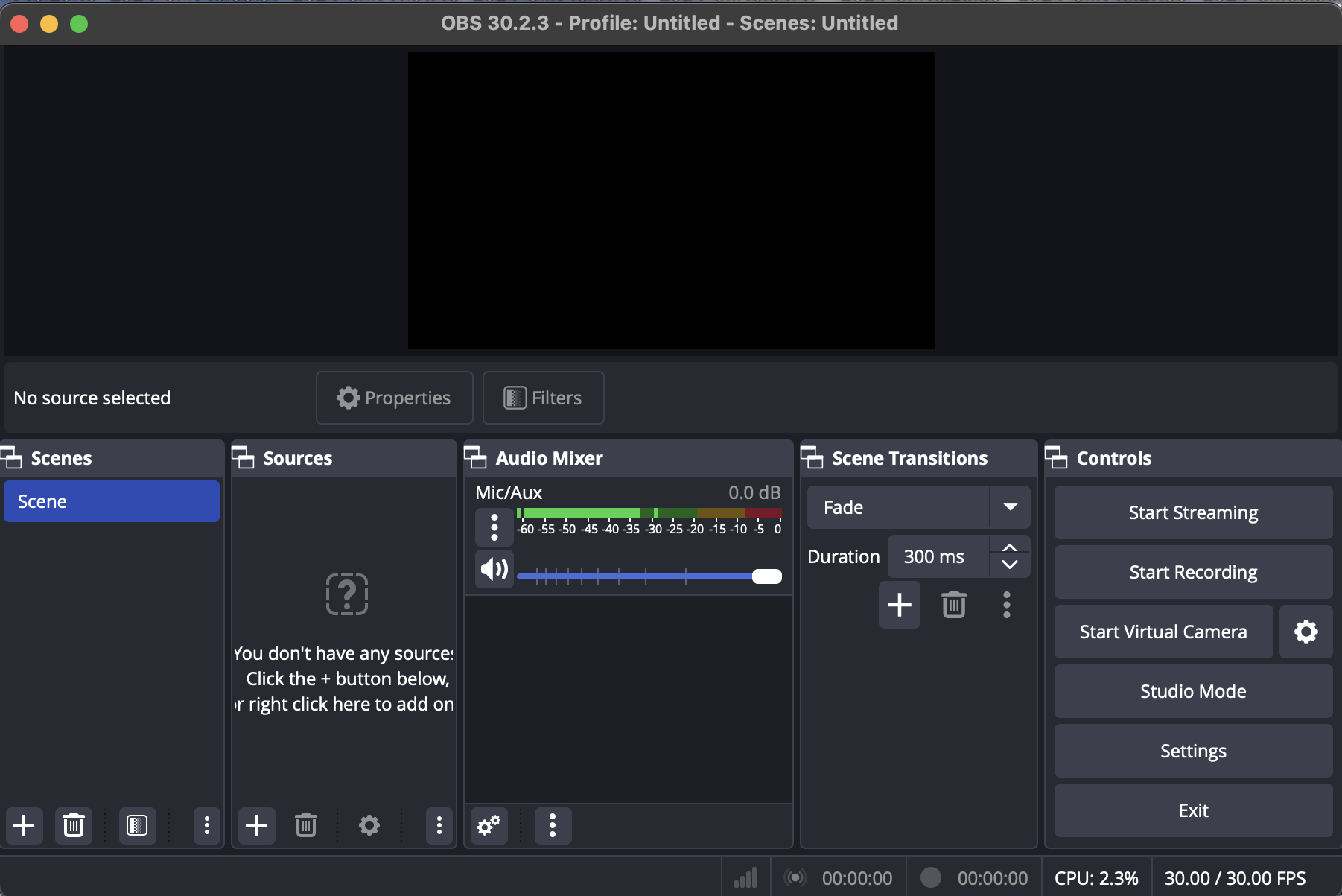
Launch OBS on your computer. If you haven’t installed it yet, grab it from the official OBS website. Once it opens, you’ll see the main layout: Scenes, Sources, Audio Mixer, and Controls.
Step 2: Find Your Microphone in the Audio Mixer
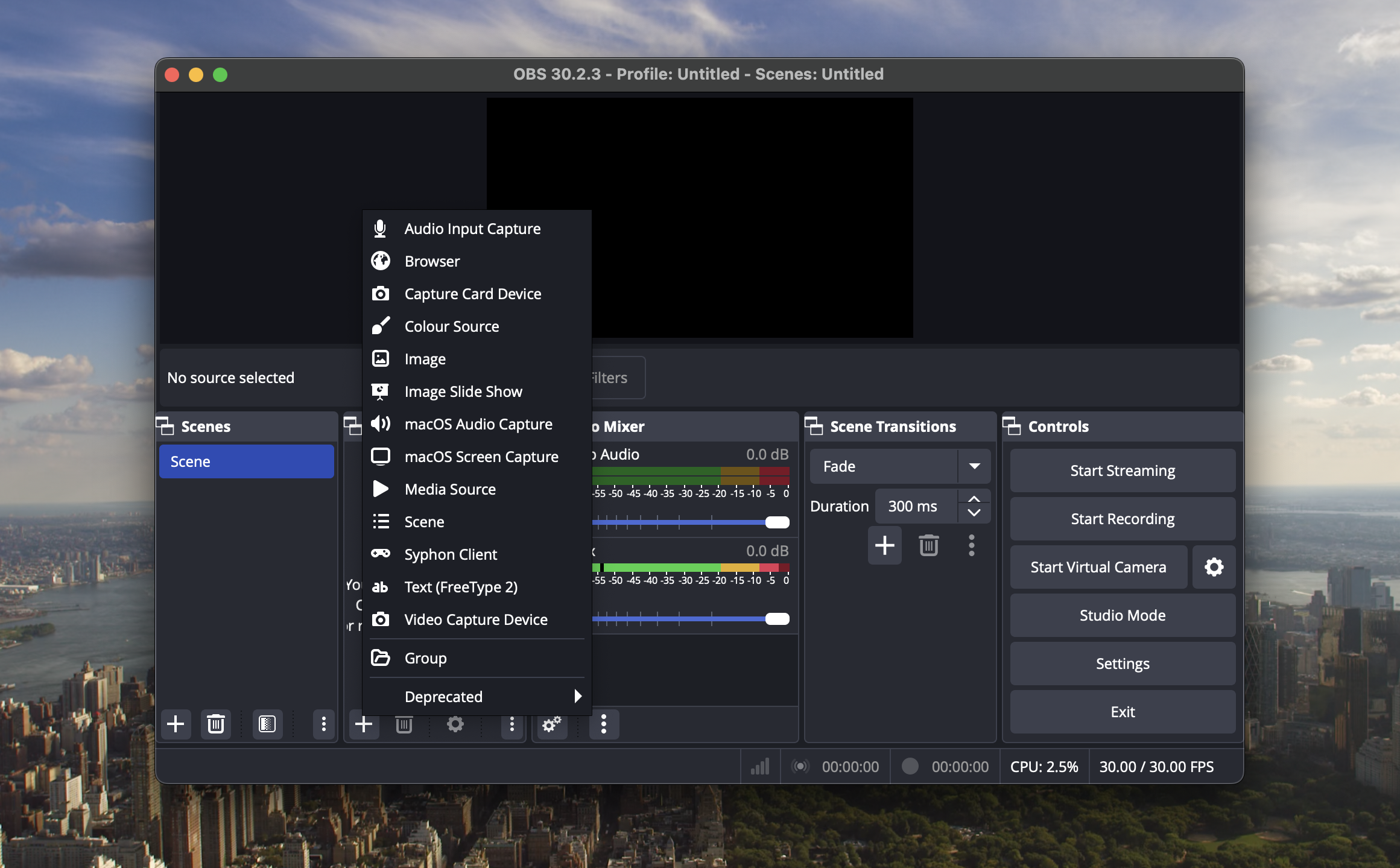
In the Audio Mixer section, locate the mic you want to clean up. If it isn’t there yet, click the + in the Sources panel, choose Audio Input Capture, and select your microphone from the list.
Step 3: Add the Noise Suppression Filter
Now apply the filter:
Click the gear icon next to your mic in the Audio Mixer and choose Filters.
In the Filters window, click + at the bottom left and select Noise Suppression.
Open the Method dropdown. You’ll see RNNoise, Speex, and (if you’ve installed the NVIDIA Broadcast SDK) NVIDIA Noise Removal.
Pick your method:
RNNoise is the best starting point for most people. It removes noise well and keeps your voice natural, at the cost of a little extra CPU.
Speex is lighter and gives you a suppression slider. Push it too far and your voice starts sounding robotic, so ease into it.
NVIDIA Noise Removal needs the NVIDIA Broadcast SDK and an RTX GPU. Once installed, it appears in the same dropdown.
RNNoise has no settings to fuss with, so if you pick it, you’re basically done.
Step 4: Record a Test Clip
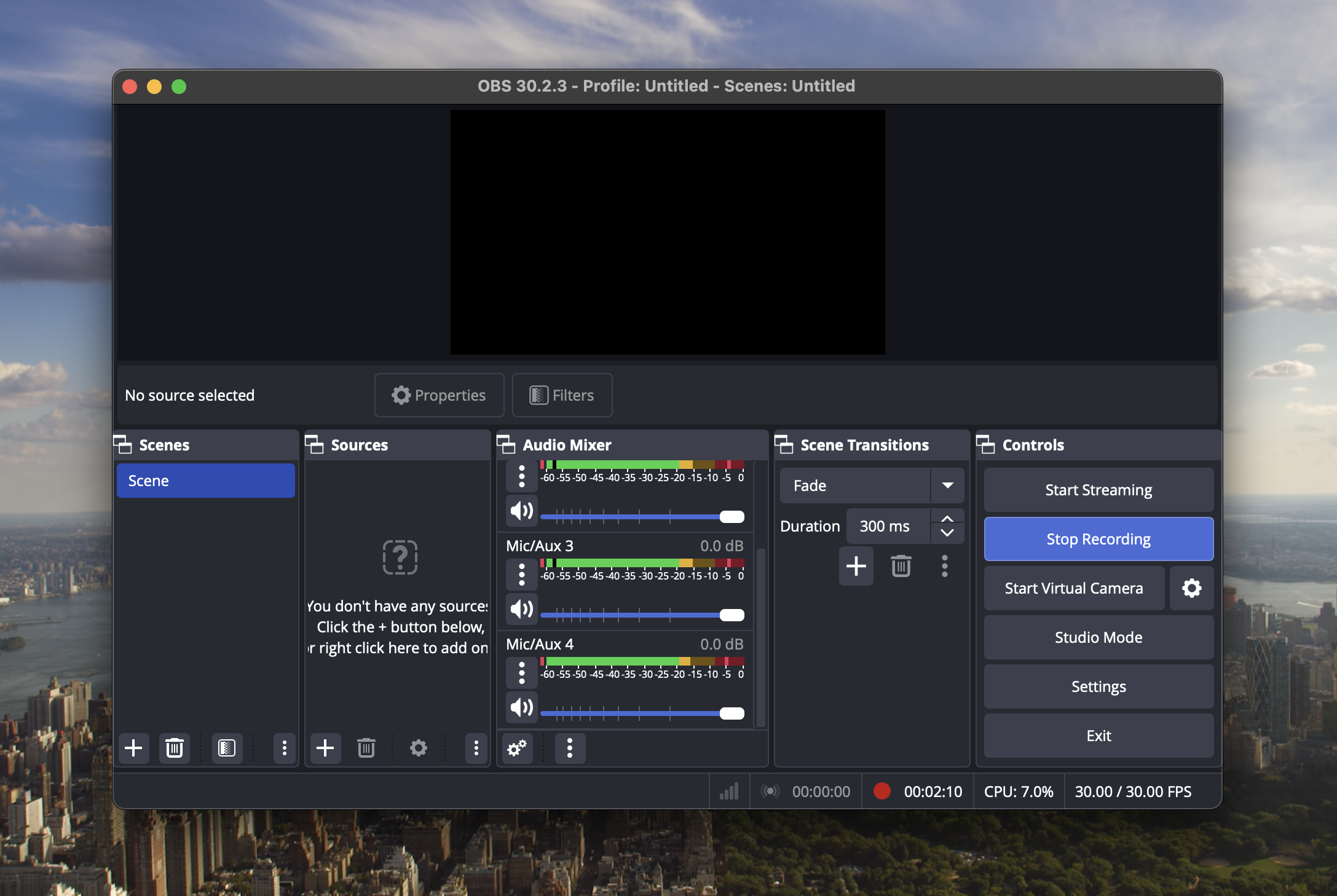
Never trust noise suppression until you’ve heard it. In Controls, click Start Recording, talk for 20–30 seconds in your usual setup, then stop and play it back. Listen for two things: leftover noise, and whether your own voice sounds thin or underwater. If the voice suffers, your suppression is too aggressive. Dial it back.
Setting Up a Noise Gate in OBS
Noise suppression and a noise gate solve different problems, and the best mic chains use both. Suppression cleans the noise that plays while you talk. A noise gate mutes your mic completely when you go quiet, so silences between sentences are truly silent instead of a low hiss.
To add one, open Filters on your mic again, click +, and choose Noise Gate. The two settings that matter are the Close Threshold (the volume level where the mic cuts off) and the Open Threshold (where it kicks back in). A safe starting point is a lower Close Threshold, around -50 dB, and a higher Open Threshold, around -35 dB, then adjust to your voice and room until the gate opens the instant you speak and closes cleanly when you stop.
Dialing in the exact numbers takes a little trial and error. Our full noise gate settings guide breaks down attack, hold, and release times if you want to get it right.
The Recommended OBS Filter Order
Order matters, because each filter hands its output to the next one. For a clean voice chain, add your filters top to bottom like this:
Noise Suppression — strip the background noise first.
Noise Gate — mute the gaps once the noise floor is lower.
Compressor (optional) — even out your volume so you’re not loud one second and quiet the next.
Putting the gate before suppression tends to cause choppy cut-offs, so keep suppression at the top.
Using Krisp With OBS for AI Noise Cancellation
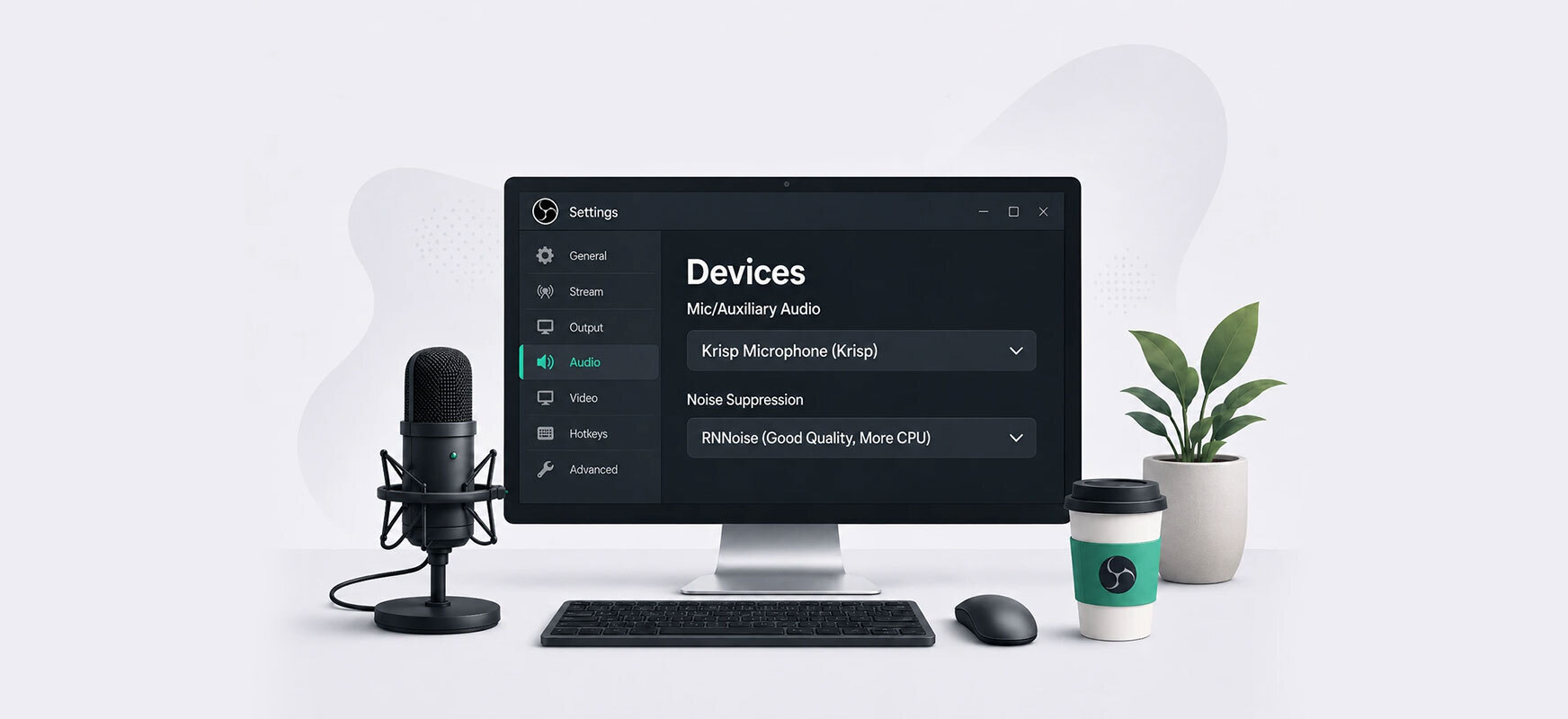
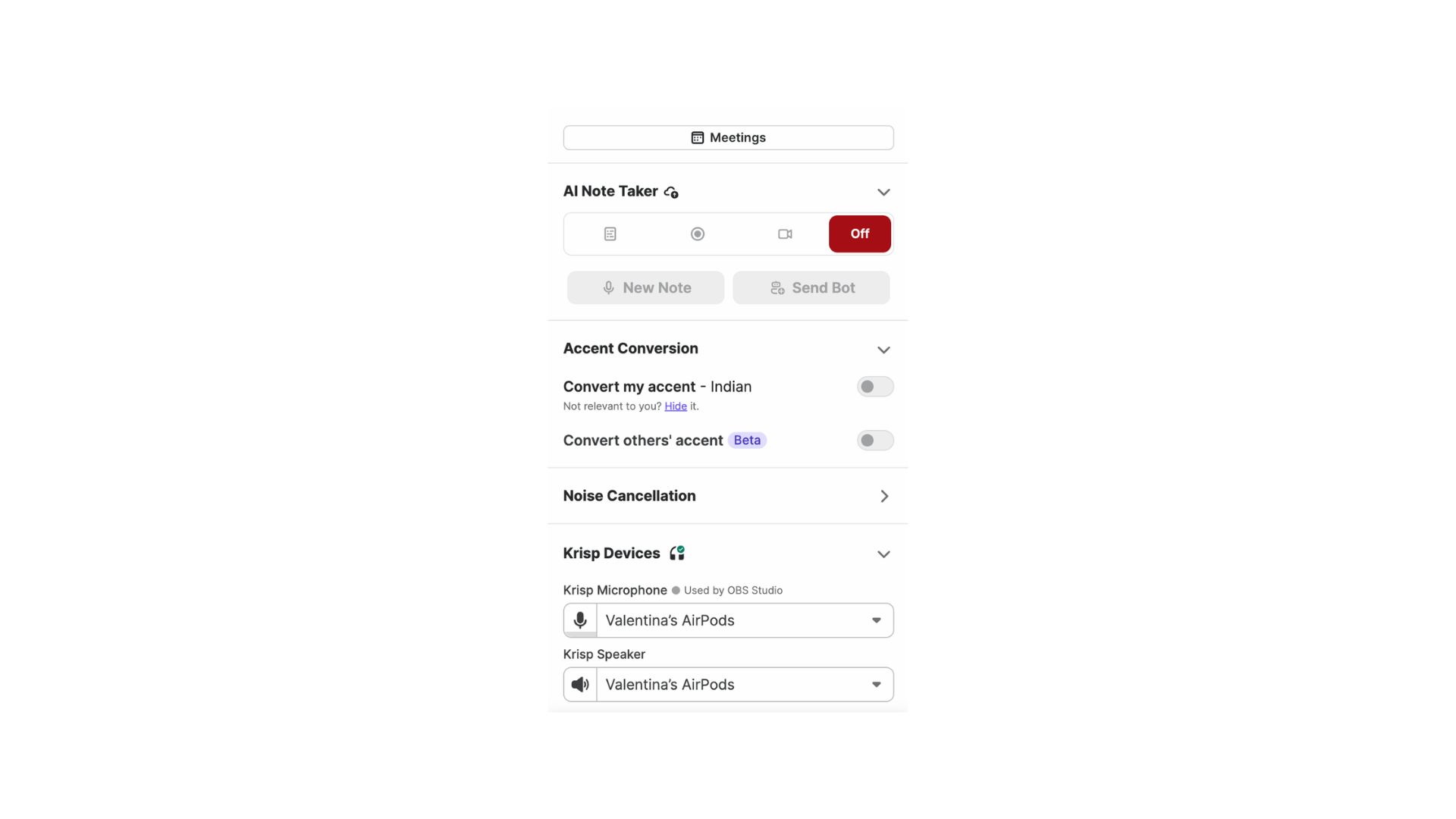
If the built-in filters can’t keep up with your environment, or you’re on a laptop without an RTX GPU, you can run AI noise cancellation through Krisp instead. Krisp isn’t a filter inside OBS. It’s a separate app that creates a virtual microphone, cleans your audio in real time, and then feeds the clean signal into OBS as your mic.
I tested this in a room with a box fan running and someone typing next to me. OBS’s RNNoise filter thinned out the fan but the keyboard still clicked through. Routing the mic through Krisp first cut both, and my voice stayed intact.
Setting it up takes three steps:
Download and install Krisp from the official site, then follow the setup wizard.
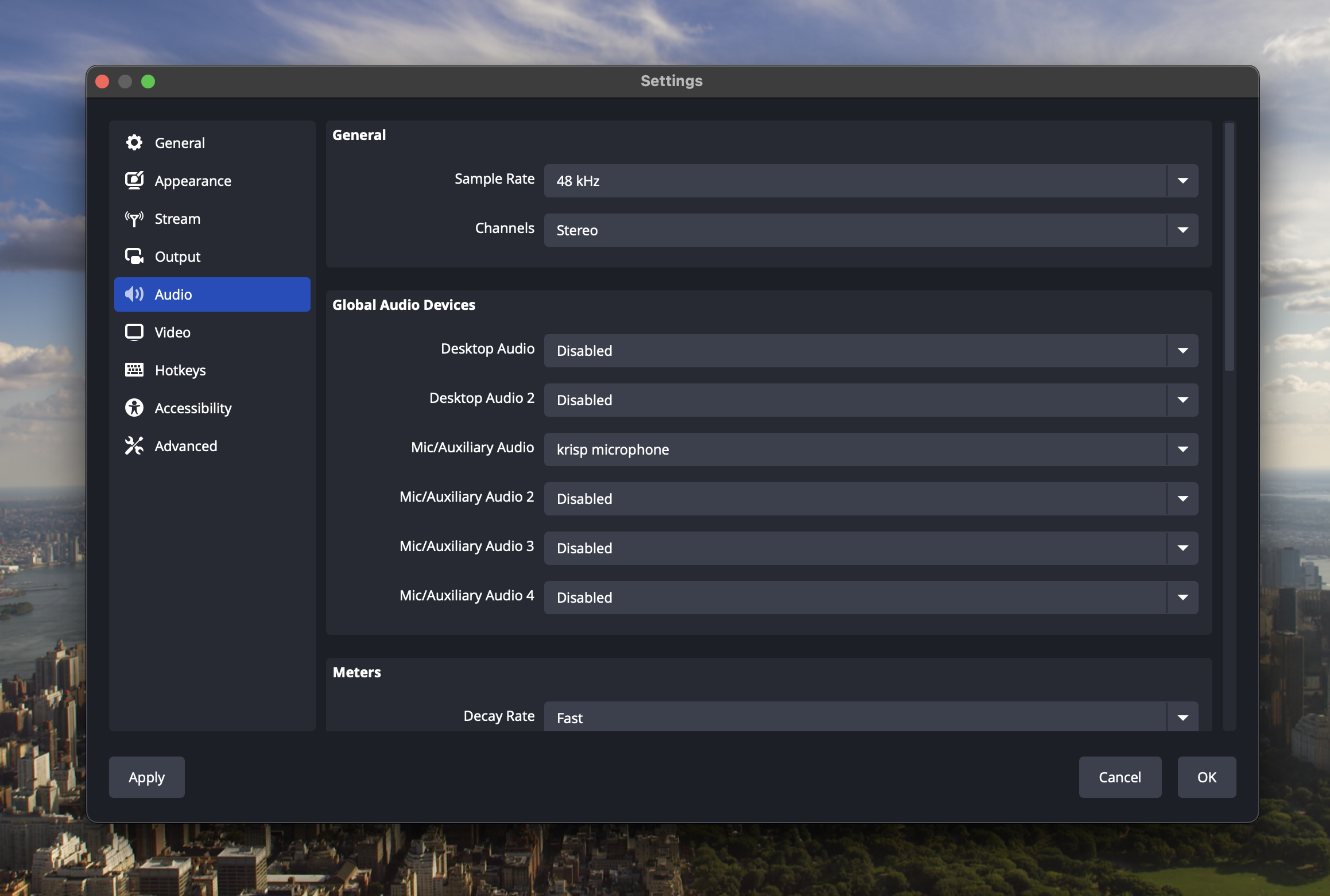
In OBS, open your audio settings and set the Mic/Auxiliary Audio device to Krisp Microphone.
Start recording or streaming. OBS now receives audio that Krisp has already cleaned.
Because Krisp processes audio before it reaches OBS, it works the same whether you’re on Windows or macOS, and it doesn’t lean on your GPU. There’s a free plan to try it, and it holds a 4.6/5 rating on G2 from more than 1,000 reviews as of July 2026. If you’d rather follow Krisp’s own walkthrough, they have a step-by-step OBS setup guide.
Fixing Distorted or Muffled Audio After Noise Suppression
Aggressive noise suppression is the usual reason a stream sounds thin, robotic, or underwater. If that’s happening, work through these fixes.
Lower the suppression level. On Speex especially, back the slider off until your voice sounds natural again. You want the lightest setting that still handles the noise.
Quiet the source. Suppression works better when there’s less to remove. Close a window, move away from the fan, or add a little soft furnishing to the room.
Fix your mic setup first. Move the mic closer, adjust the gain, and add a pop filter for plosives. A cleaner input needs far less processing.
Watch your levels. If your mic input is peaking, you’ll get clipping that no filter can undo. Keep the meter out of the red.
Update OBS. Newer builds ship fixes and improvements to the audio filters, so run the current version before you troubleshoot anything deeper.
NVIDIA option not showing? The NVIDIA Noise Removal method only appears after you install the NVIDIA Broadcast SDK on a supported RTX GPU. No SDK, no option.
Still not clean enough? When the room is the problem, no amount of tuning fixes it. That’s the point to switch to a dedicated AI tool like Krisp, which handles messy environments the built-in filters weren’t built for. If you’re curious how the technology differs, here’s how noise cancellation actually works.
Yes. OBS Studio has a built-in Noise Suppression filter that you can add to any audio source. It supports three methods: RNNoise, Speex, and NVIDIA Noise Removal. RNNoise is the default option and works well for most setups.
Click the gear icon next to your microphone in the Audio Mixer, select Filters, click the + button, and choose Noise Suppression. Then select a suppression method from the dropdown menu. RNNoise does not require any additional configuration.
RNNoise generally provides better sound quality and keeps your voice more natural, but it uses slightly more CPU. Speex is lighter and adjustable, making it more suitable for older or lower-spec computers. Start with RNNoise and switch to Speex only if performance becomes an issue.
Noise suppression reduces background noise while you are speaking. A noise gate mutes the microphone when the audio level falls below a set threshold, keeping silent moments quiet. Using both filters can produce cleaner audio.
Your noise suppression may be too aggressive. Reduce the suppression level, especially when using Speex, improve your microphone position, and test the audio again. If your voice still sounds muffled, an AI noise-cancellation tool such as Krisp can remove background noise while preserving voice clarity.
Yes. Krisp works as a virtual microphone. Install the Krisp app, select Krisp Microphone as your microphone source in OBS, and OBS will receive audio that has already been cleaned. Krisp works on Windows and macOS and does not require an NVIDIA GPU.
No. RNNoise and Speex work without an NVIDIA GPU. An eligible NVIDIA GPU and the required NVIDIA software are only needed for the NVIDIA Noise Removal method. Krisp is another GPU-independent option for removing more challenging background noise.










 Because Krisp processes audio before it reaches OBS, it works the same whether you’re on Windows or macOS, and it doesn’t lean on your GPU. There’s a free plan to try it, and it holds a 4.6/5 rating on G2 from more than 1,000 reviews as of July 2026. If you’d rather follow Krisp’s own walkthrough, they have a